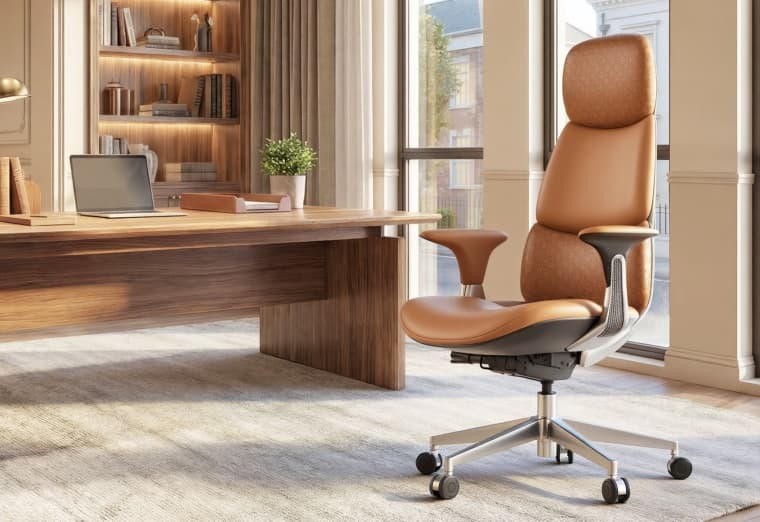
Article: For office chairs, is real leather better than artificial leather?
For office chairs, is real leather better than artificial leather?
When purchasing a leather executive chair, real leather and artificial leather are often the first two materials consumers need to compare. For office chairs, is real leather better than artificial leather? The answer is not a simple "yes" or "no". Real leather usually has advantages in touch, texture after long-term use, and durability potential, while artificial leather such as PU leather is usually lower in price, uniform in appearance, and easier to perform daily cleaning on. For people who use office chairs for long periods every day, what truly needs to be considered is whether the material, chair structure, ergonomic design, budget, and usage environment match each other.
To judge whether a real leather office chair is worth buying, one cannot only look at material labels like "Genuine Leather" or "PU Leather", but should also understand factors that affect the long-term usage experience, such as the actual leather coverage area, leather grade, internal padding, backrest structure, and mechanism.
What are the differences between real leather office chairs and artificial leather office chairs?
Real leather comes from animal hides and is used in furniture and office chair manufacturing after tanning, dyeing, and surface processing. Natural leather usually retains certain natural textures, so slight differences in color and texture may exist in different areas.
Artificial leather commonly found in office chairs mainly includes materials such as PU Leather (polyurethane artificial leather). It usually uses fabric as a base layer and adds a polymer coating on the surface to simulate the color and texture of natural leather.
The biggest difference between the two is not just "natural" and "artificial". Real leather may gradually form more natural signs of use and sheen during long-term use, while artificial leather usually has a more uniform appearance. However, for consumers with limited budgets, lower usage frequency, or who place more value on cleaning convenience, artificial leather still possesses practical value.
Which is more durable, real leather or artificial leather?
High-quality real leather, after reasonable use and maintenance, usually has good long-term potential for use. Natural leather possesses a fiber structure, and during the process of use, wrinkles, color changes, and natural sheen may gradually appear; these changes do not necessarily represent that the leather is damaged.
The durability of artificial leather, on the other hand, is closely related to the quality of the surface coating, base layer material, ambient temperature, humidity, and frequency of use. Along with long-term friction and aging, some artificial leather may experience surface cracking, peeling, or local wear.
However, this does not mean that all real leather is definitely more durable than all artificial leather. Low-grade or improperly treated real leather can likewise experience problems like drying and fading; high-quality artificial leather can also possess a decent lifespan. Therefore, when comparing real leather and PU leather office chairs, a more reasonable approach is to evaluate based on the specific material grade, manufacturing craft, and product structure.
Is a real leather office chair definitely more comfortable to sit on?
The surface of real leather usually possesses natural textures and a soft touch, and as usage time increases, the leather may gradually adapt to force changes on the seat surface. However, if the foam inside the seat cushion lacks support, or if the curve of the backrest does not match the body, even using high-grade real leather cannot guarantee long-term sitting comfort.
For executive leather chairs, the seat cushion usually adopts a foam and leather-wrapped structure, so one needs to pay attention to both the support and resilience performance of the foam. A seat cushion that is too soft may feel comfortable when first sitting down, but after long-term use it may not necessarily provide stable support; being too hard, on the other hand, may increase local pressure.
Therefore, when purchasing a leather chair, do not judge comfort solely by touching the surface with your hands, but rather pay more attention to the chair structure, filling materials, and ergonomic design.

What should be looked at for the ergonomic design of an executive leather chair?
Traditional executive leather chairs emphasize a thick and wide appearance, whereas modern ergonomic executive chairs increasingly value body support during long office hours.
First, one should pay attention to lumbar and back support. The backrest should be able to naturally support the back, rather than purely relying on a large amount of padding to create a soft feeling.
Second is the seat height. A suitable height should allow both feet to stably contact the ground and keep the legs in a relatively natural position.
Armrests are also worth paying attention to. For people who type, attend video meetings, or process documents for long periods, the height and position of the armrests should keep the shoulders naturally relaxed.
In addition, backrest tilt and tilt tension adjustment allow the user to change sitting postures between focused work, meetings, reading, and brief rest. A truly excellent real leather ergonomic office chair should achieve a balance between the wrapping sensation of an executive chair and ergonomic support.
Is a real leather office chair more breathable than an artificial leather one?
Natural leather possesses a fiber structure distinct from synthetic coating materials, but the actual sitting experience is still affected by the leather's surface treatment, thickness, indoor temperature, clothing, and seat padding structure. Therefore, one cannot simply assume that all real leather office chairs will be cooler under any environment.
Artificial leather such as PU usually adopts a more continuous surface coating, and in hot environments or during long periods of body contact, some users may feel it is more stuffy and hot.
If the office uses air conditioning year-round, the difference in physical sensation between the two materials may not become a decisive factor; if the region you are in has hot summers, or if you need to sit continuously for long periods every day, you can include breathability and temperature experience in your purchasing considerations.
Which is easier to clean, a real leather or an artificial leather office chair?
In terms of daily cleaning, artificial leather is usually more convenient. Most daily dust and slight stains can be handled using a soft, slightly damp cloth, but specific care instructions provided by the product manufacturer should still be followed.
Real leather requires more caution. Daily cleaning can use a soft dry cloth or a cleaning method suitable for the corresponding leather type, while avoiding long-term exposure to intense sunlight, heat sources, or overly dry environments.
For natural leather, it is also not recommended to casually use alcohol, strong detergents, or chemical products unsuitable for leather, as these products may damage the surface treatment layer.
If you hope the office chair requires almost no extra care, artificial leather may be more convenient; if you are willing to perform appropriate maintenance and place greater value on long-term texture, a real leather executive chair is more worth considering.
What kind of office space is a real leather executive chair suitable for?
Black or dark brown real leather executive chairs are usually suitable for management offices, law firms, financial institutions, conference rooms, and more traditionally styled workspaces. The natural leather texture can form a harmoniously coordinated combination with solid wood desktops, metal furniture, and dark storage cabinets.
If the office adopts a modern minimal style, you can consider black, brown, or light-colored leather chairs with cleaner contours to avoid overly bulky backrest and armrest designs.
Because artificial leather has high consistency in color and texture, it also possesses advantages when batch-configuring conference rooms, shared offices, or multiple workstations, making it easier to maintain visual unity throughout the space.

How should you choose between real leather and artificial leather office chairs?
If you are comparing real leather and artificial leather office chairs, you can start evaluating from the frequency of use.
For people who work long hours every day and plan to use one chair for many years, you can focus on leather quality, seat support, mechanism structure, and long-term maintenance costs, rather than only paying attention to the initial retail price.
If it is mainly used for home offices, conference rooms, or occasional work, artificial leather may satisfy basic needs with a lower budget.
For corporate management offices or users who hope to obtain a more traditional, mature space texture, real leather executive chairs usually possess stronger material expressiveness.
Regardless of which one you choose, it is recommended to check whether the product clearly specifies the seat material, leather coverage area, adjustment functions, seat dimensions, weight capacity range, and main structural configurations. The more transparent the information, the easier it is to conduct a truly meaningful product comparison.
Frequently Asked Questions About Real Leather and Artificial Leather Office Chairs
Is a real leather office chair definitely better than a PU leather office chair?
Not necessarily. Real leather usually possesses a more natural texture and better long-term use potential, whereas PU leather is lower in price, uniform in appearance, and convenient for daily cleaning. Ultimately, one should evaluate based on budget, frequency of use, and the overall quality of the chair.
How to tell if an office chair is real leather?
Do not judge based solely on product photos. When purchasing, check the product material description and confirm which specific areas use real leather. Some office chairs may only use real leather on the main contact areas of the seat and backrest, while other parts use matching materials.
Will a real leather office chair crack?
Natural leather can also experience drying and surface damage due to long-term sun exposure, high temperatures, excessive dryness, or improper care methods. Reasonable cleaning and maintenance help maintain the leather condition.
Is a real leather executive chair suitable for working 8 hours a day?
Whether it is suitable for long working hours mainly depends on seat dimensions, lumbar and back support, foam, armrests, and tilt structure, rather than judging solely by the real leather material. If you sit for long hours every day, priority should be given to executive leather chairs with reasonable ergonomic design.
What should be paid attention to most when buying an executive leather chair?
It is recommended to judge in the order of ergonomic and dimension matching → chair structure → leather material → adjustment functions → appearance design, rather than being attracted first by the "real leather" label or a bulky appearance.